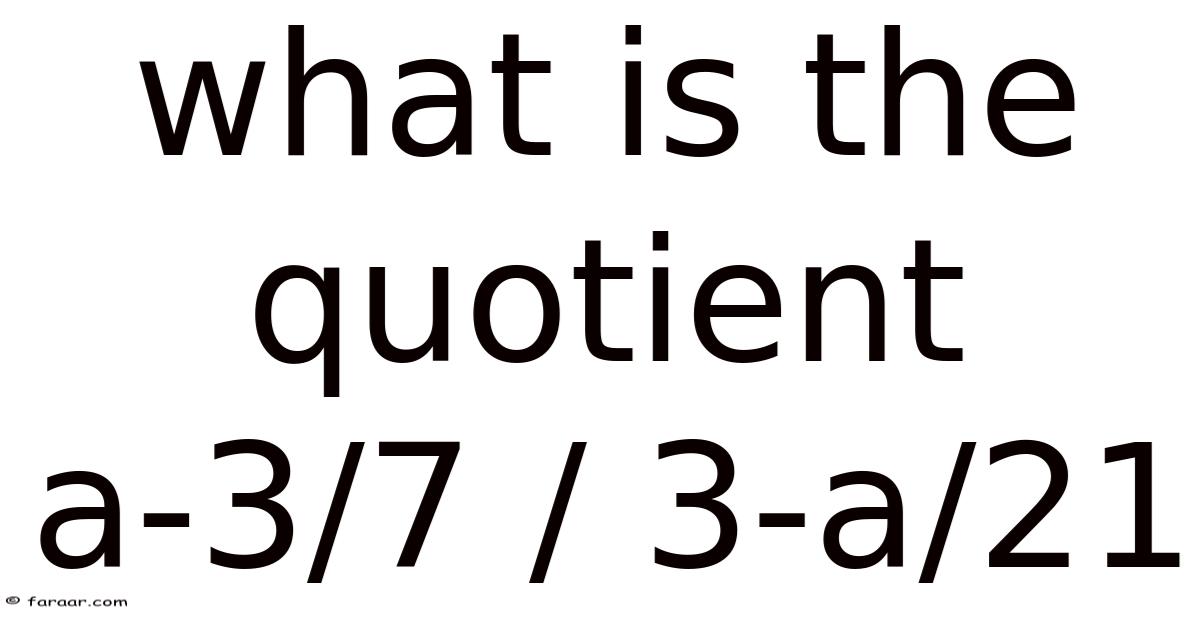
Simplifying Algebraic Fractions: Understanding the Quotient (a-3)/7 / (3-a)/21
This article will dig into the simplification of the algebraic fraction (a-3)/7 / (3-a)/21, explaining the process step-by-step and providing a deeper understanding of the underlying mathematical principles. We'll cover the key concepts involved, including working with fractions, factoring, and understanding the relationship between (a-3) and (3-a). So this guide is designed for students and anyone seeking to improve their understanding of algebraic manipulation. By the end, you'll not only know the solution but also grasp the reasoning behind each step.
Introduction: Navigating the World of Algebraic Fractions
Working with algebraic fractions might seem daunting at first, but with a systematic approach, it becomes a manageable and even enjoyable process. And the problem before us, (a-3)/7 / (3-a)/21, involves dividing one algebraic fraction by another. Worth adding: this involves identifying common factors and applying the principles of factoring to reduce the complexity of the expression. Which means the ultimate goal is to express the given quotient in its simplest form. Practically speaking, the key to solving this lies in understanding the rules of fraction division and recognizing opportunities to simplify the expression. We'll break down the solution methodically, ensuring that every step is clear and easy to follow That's the whole idea..
Step-by-Step Solution: Simplifying the Quotient
Let's tackle the problem step-by-step:
-
Understanding Fraction Division: Remember that dividing by a fraction is the same as multiplying by its reciprocal. This is a fundamental rule in arithmetic that also applies to algebraic fractions. Which means, our problem can be rewritten as:
(a-3)/7 * 21/(3-a)
-
Identifying Common Factors: Now, let's look for common factors in the numerator and denominator. Notice that (a-3) and (3-a) are almost identical, except for the negative sign. We can factor out a -1 from (3-a) to obtain -(a-3). This is a crucial step in simplification That's the part that actually makes a difference..
-
Substitution and Simplification: Substituting -(a-3) for (3-a), our expression becomes:
(a-3)/7 * 21/(-(a-3))
-
Cancellation of Common Factors: Observe that (a-3) appears in both the numerator and the denominator. Since (a-3)/(a-3) = 1 (provided a ≠ 3), we can cancel these terms:
1/7 * 21/(-1)
-
Final Simplification: Now, we can simplify the numerical part of the fraction:
21/7 = 3
Because of this, our simplified expression becomes:
3/(-1) = -3
Which means, the simplified form of (a-3)/7 / (3-a)/21 is -3.
Explanation of the Mathematical Principles Involved
The solution hinges on several key mathematical principles:
-
Fraction Division: The core principle is transforming division of fractions into multiplication by the reciprocal. This is a cornerstone of fraction arithmetic and algebra.
-
Factoring: Factoring out a -1 from (3-a) is essential to reveal the common factor (a-3). Factoring is a powerful technique used extensively in simplifying algebraic expressions. It allows us to identify common elements that can be canceled.
-
Cancellation of Common Factors: This is based on the property that x/x = 1, provided x ≠ 0. This allows us to simplify fractions significantly by eliminating common factors in the numerator and denominator.
-
Properties of Negative Numbers: Understanding how negative numbers interact with algebraic expressions is crucial. In this case, factoring out -1 from (3-a) leads to -(a-3), enabling simplification It's one of those things that adds up..
Addressing Potential Questions and Concerns (FAQ)
-
What if a = 3? If a = 3, the original expression becomes undefined because it involves division by zero. The expression (a-3) in the denominator would become 0, making the fraction undefined. Our simplified solution (-3) is valid only when a ≠ 3.
-
Why is factoring so important? Factoring is crucial for simplifying algebraic expressions. It allows us to identify and cancel common factors, leading to a more concise and manageable form of the expression. Without factoring, simplifying complex fractions would be extremely difficult Still holds up..
-
Can we solve this using a different approach? While the method outlined above is the most efficient, other approaches might involve expanding the fractions and then simplifying. That said, these methods would likely be more time-consuming and prone to errors. The direct approach of using reciprocals and factoring is highly recommended for its efficiency and clarity Small thing, real impact..
-
Are there any other similar problems I can practice with? Yes! Practice is key to mastering algebraic fraction simplification. You can create similar problems by changing the numerical coefficients and the algebraic expressions. Try varying the signs to understand their impact on the final result. The more you practice, the more confident you'll become in handling these types of problems.
Conclusion: Mastering Algebraic Fraction Simplification
Simplifying algebraic fractions is a fundamental skill in algebra and beyond. By systematically applying these principles, we were able to reduce a complex-looking fraction to its simplest form (-3), provided a ≠ 3. That's why the more problems you solve, the more comfortable and efficient you will become at simplifying algebraic fractions. That's why this understanding extends to more advanced mathematical concepts, making mastering this skill a valuable investment in your mathematical journey. The process may seem complex at first, but with consistent effort and practice, you'll find it becomes increasingly intuitive and straightforward. This problem demonstrated the importance of understanding fraction division, factoring, and the manipulation of negative numbers. On top of that, don't hesitate to review the steps and principles discussed here to reinforce your understanding and build confidence in tackling similar problems. Even so, remember, practice is essential to mastering these concepts. Keep practicing, and you'll soon be proficient in simplifying algebraic fractions!
