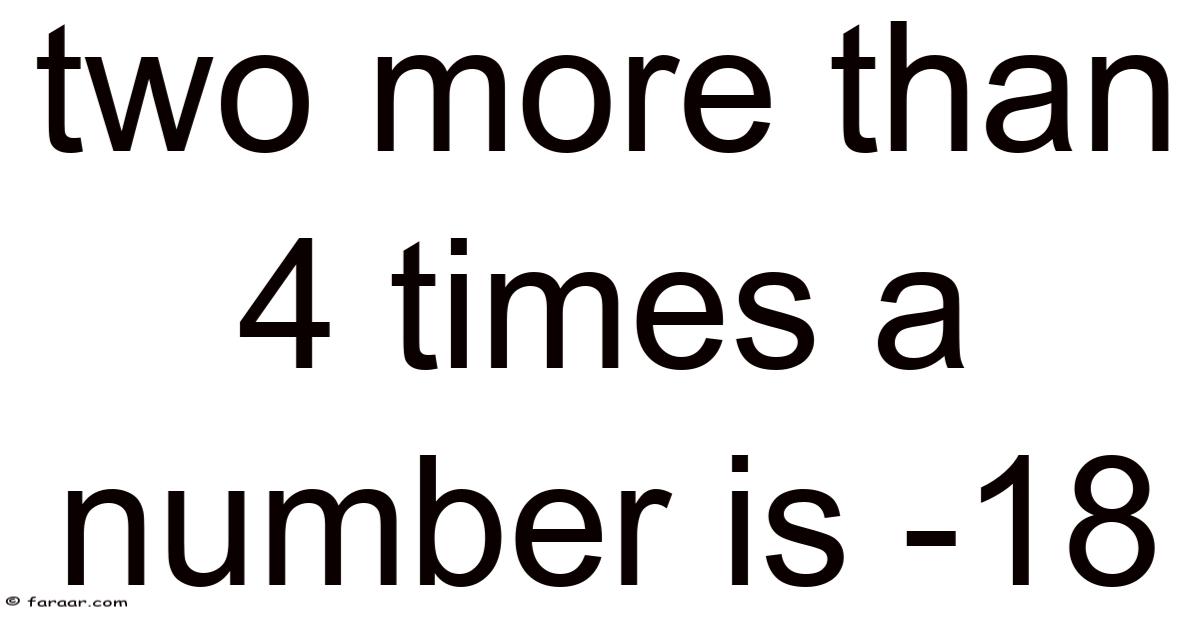
Two More Than 4 Times a Number is -18: Unraveling the Mystery of Algebraic Equations
This article gets into the seemingly simple yet fundamentally important algebraic equation: "Two more than 4 times a number is -18." We'll break down how to solve this equation step-by-step, explain the underlying mathematical principles, explore different approaches to solving similar problems, and finally, address some frequently asked questions. Understanding this type of problem is crucial for mastering fundamental algebra and building a solid foundation for more advanced mathematical concepts. By the end, you'll not only know the answer but also understand the why behind the solution.
Understanding the Problem: Translating Words into Math
The phrase "Two more than 4 times a number is -18" might seem daunting at first, but it's simply a word problem cleverly disguised as an algebraic equation. Let's break it down piece by piece:
- "a number": This represents an unknown value, which we typically denote with a variable, usually x.
- "4 times a number": This translates directly to 4x or 4x.
- "Two more than 4 times a number": This means we add 2 to the previous result, giving us 4x + 2.
- "is -18": This signifies that the expression 4x + 2 equals -18.
Because of this, the complete algebraic equation is: 4x + 2 = -18
Solving the Equation: A Step-by-Step Guide
Now that we've translated the word problem into an algebraic equation, we can solve for x. We'll use a systematic approach to ensure clarity and accuracy. The goal is to isolate x on one side of the equation.
Step 1: Subtract 2 from both sides
Our equation is 4x + 2 = -18. To begin isolating x, we need to eliminate the "+2." We do this by subtracting 2 from both sides of the equation.
4x + 2 - 2 = -18 - 2
This simplifies to:
4x = -20
Step 2: Divide both sides by 4
Now, we have 4x = -20. To solve for x, we need to get rid of the "4" that's multiplying x. We do this by dividing both sides of the equation by 4:
4x / 4 = -20 / 4
This simplifies to:
x = -5
Because of this, the number is -5.
Verification: Checking Our Answer
It's crucial to verify our solution. Let's substitute x = -5 back into the original equation:
4x + 2 = -18
4(-5) + 2 = -18
-20 + 2 = -18
-18 = -18
The equation holds true, confirming that our solution, x = -5, is correct It's one of those things that adds up..
The Underlying Mathematics: Properties of Equality
The process of solving this equation relies on fundamental properties of equality. These properties make sure we maintain the balance of the equation throughout the solving process. The key properties used here are:
- Subtraction Property of Equality: If you subtract the same number from both sides of an equation, the equation remains true.
- Division Property of Equality: If you divide both sides of an equation by the same non-zero number, the equation remains true.
These properties are the bedrock of algebraic manipulation and are essential for solving a wide range of equations And it works..
Alternative Approaches: Different Paths to the Same Solution
While the step-by-step method above is clear and efficient, there are other approaches to solve the equation 4x + 2 = -18. These alternative methods demonstrate the flexibility of algebra and can be useful depending on the complexity of the problem:
-
Using Inverse Operations: This method focuses on applying inverse operations to isolate x. Subtraction is the inverse of addition, and division is the inverse of multiplication. We systematically apply these inverse operations to undo the operations performed on x Practical, not theoretical..
-
Graphical Method: This approach involves graphing the equation y = 4x + 2 and finding the x-intercept (where y = -18). The x-coordinate of the x-intercept represents the solution to the equation. This method provides a visual representation of the solution.
-
Trial and Error: For simpler equations, a trial-and-error approach might be used. You could try different values of x until you find one that satisfies the equation. On the flip side, this method becomes less efficient as equations become more complex.
Expanding the Understanding: Solving Similar Equations
The principles used to solve "Two more than 4 times a number is -18" can be applied to a wide range of similar algebraic equations. Consider these examples:
-
Three less than twice a number is 7: This translates to 2x - 3 = 7. The solution process is analogous to the original problem.
-
Five more than one-third of a number is 9: This translates to (1/3)x + 5 = 9. The solution process involves multiplying both sides by 3 to eliminate the fraction before isolating x.
-
The sum of a number and its double is 15: This translates to x + 2x = 15, which simplifies to 3x = 15 The details matter here..
Each of these examples requires the same fundamental algebraic principles: translating words into mathematical symbols, applying properties of equality, and systematically isolating the variable to find the solution.
Frequently Asked Questions (FAQ)
Q1: What if the equation was more complex, involving multiple variables or exponents?
A1: More complex equations require more advanced algebraic techniques. These might include techniques like factoring, using the quadratic formula, or employing systems of equations. The fundamental principles of maintaining equation balance remain the same, but the methods for manipulating the equation become more sophisticated.
Q2: Why is it important to verify the solution?
A2: Verifying the solution is crucial to ensure accuracy. Plus, it confirms that the calculated value of x actually satisfies the original equation. Without verification, there's a possibility of errors in the calculation process going undetected.
Q3: Are there any real-world applications of solving algebraic equations like this?
A3: Yes, algebraic equations are used extensively in various fields. Examples include calculating distances, determining speeds, analyzing financial data, modeling physical phenomena, and in many other scientific and engineering applications. The ability to solve algebraic equations is a foundational skill for numerous disciplines.
Q4: What resources are available for further learning?
A4: Numerous resources are available for learning more about algebra. Textbooks, online courses, tutorial videos, and educational websites provide comprehensive guidance and practice problems at various levels.
Conclusion: Mastering the Fundamentals
Solving the equation "Two more than 4 times a number is -18" is more than just finding the answer (-5). Because of that, it's about understanding the fundamental principles of algebra, including translating word problems into mathematical expressions, applying properties of equality, and systematically solving equations. On top of that, this understanding forms the basis for tackling more complex problems and applying algebraic concepts to real-world situations. By mastering these fundamental concepts, you open the door to a deeper understanding of mathematics and its diverse applications. Remember, practice is key to developing proficiency in algebra. So, continue solving problems, and you'll steadily build your confidence and skills Worth keeping that in mind..
