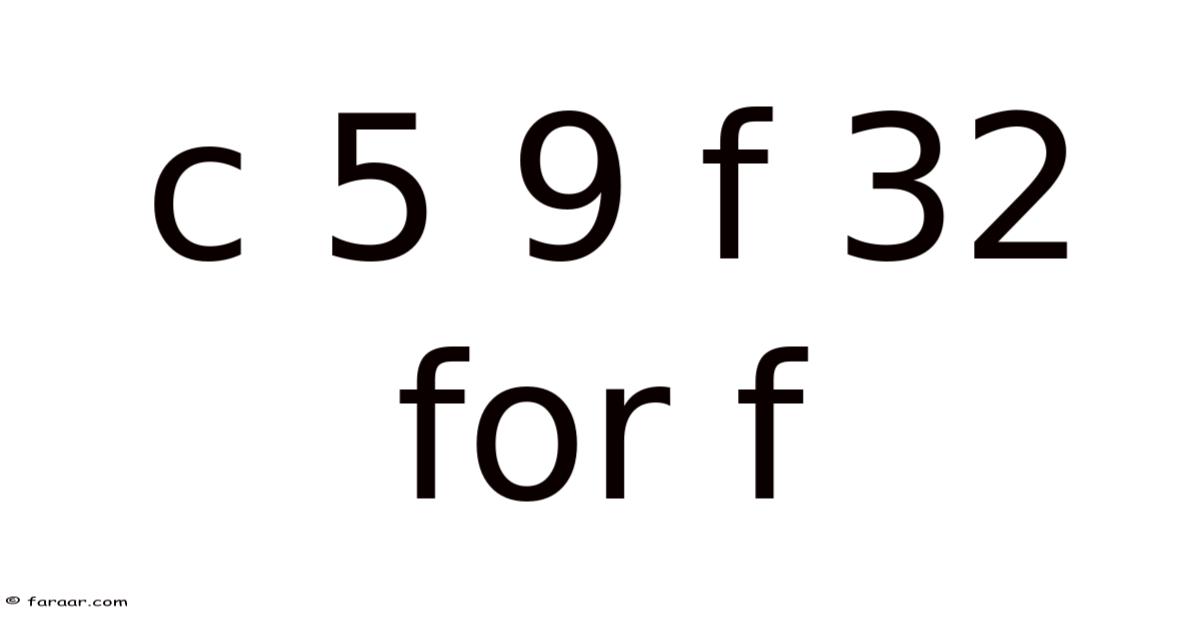
Decoding the Enigma: C 5/9 (F - 32) for Fahrenheit to Celsius Conversion
Understanding temperature conversion between Celsius and Fahrenheit is a fundamental concept in science and everyday life. This article delves deep into the formula C = 5/9 (F - 32), explaining its origin, application, and practical implications. We'll explore the underlying mathematics, provide step-by-step examples, and answer frequently asked questions to solidify your understanding of this crucial conversion Not complicated — just consistent..
Introduction: Why Convert Temperatures?
Temperature is a crucial physical property, influencing everything from weather patterns to chemical reactions. Different parts of the world use different temperature scales: Celsius (°C) and Fahrenheit (°F). Even so, the Celsius scale is based on the freezing (0°C) and boiling (100°C) points of water, while the Fahrenheit scale has different reference points (32°F for freezing and 212°F for boiling). Knowing how to convert between these scales is essential for accurate communication and scientific calculations across international contexts. This is where the equation C = 5/9 (F - 32) comes into play, allowing for seamless conversion from Fahrenheit to Celsius.
Understanding the Formula: A Step-by-Step Breakdown
The formula C = 5/9 (F - 32) represents a linear transformation. Let's break down each component:
- F: This represents the temperature in Fahrenheit. This is the input value you'll start with.
- (F - 32): This part of the equation adjusts for the difference in the freezing point of water between the two scales. Fahrenheit's freezing point is 32°F, while Celsius is 0°C. Subtracting 32 from the Fahrenheit temperature aligns the scales.
- 5/9: This is the scaling factor. It accounts for the different sizes of the degrees in each scale. A change of 9°F is equivalent to a change of 5°C. Multiplying by 5/9 adjusts the magnitude of the temperature difference to fit the Celsius scale.
- C: This represents the resulting temperature in Celsius. This is the output value you'll obtain after completing the calculation.
Step-by-Step Examples: Putting the Formula into Practice
Let's work through a few examples to illustrate the application of the formula:
Example 1: Converting 68°F to Celsius
- Substitute: Replace 'F' in the formula with 68: C = 5/9 (68 - 32)
- Subtract: Perform the subtraction within the parentheses: C = 5/9 (36)
- Multiply: Multiply 36 by 5/9: C = 20
- Result: 68°F is equal to 20°C.
Example 2: Converting 212°F (Boiling Point of Water) to Celsius
- Substitute: C = 5/9 (212 - 32)
- Subtract: C = 5/9 (180)
- Multiply: C = 100
- Result: 212°F is equal to 100°C. This confirms the known boiling point of water in Celsius.
Example 3: Converting a Negative Fahrenheit Temperature to Celsius
Let's convert -4°F to Celsius:
- Substitute: C = 5/9 (-4 - 32)
- Subtract: C = 5/9 (-36)
- Multiply: C = -20
- Result: -4°F is equal to -20°C.
The Science Behind the Formula: Understanding the Linear Relationship
The formula's accuracy stems from the linear relationship between Celsius and Fahrenheit. On top of that, this means that a consistent ratio exists between changes in temperature on both scales. But the formula is derived from the known freezing and boiling points of water in both scales. In practice, by establishing two points (0°C, 32°F) and (100°C, 212°F), we can determine the slope and y-intercept of the line representing the conversion. The slope represents the 5/9 ratio, and the y-intercept is -32 (or +32 depending on which way you perform the transformation).
People argue about this. Here's where I land on it.
Beyond the Basics: Applications and Extensions
The Fahrenheit-to-Celsius conversion formula has wide-ranging applications, including:
- Meteorology: Converting weather reports between different units of measurement.
- Cooking and Baking: Precise temperature control is crucial for successful culinary outcomes. Recipes often use either Fahrenheit or Celsius, requiring conversion for accurate results.
- Engineering and Science: Consistent temperature units are necessary for accurate calculations and data analysis in many scientific and engineering applications.
- Medicine: Accurate temperature readings are essential for medical diagnoses and treatment.
Frequently Asked Questions (FAQ)
Q: Can I convert Celsius to Fahrenheit using a similar formula?
A: Yes, the reverse conversion is given by the formula: F = (9/5)C + 32.
Q: Why is the formula structured the way it is? Why subtract 32 before multiplying by 5/9?
A: Subtracting 32 first aligns the zero points of the two scales. The multiplication by 5/9 then scales the temperature difference to reflect the ratio of the degree sizes. If you multiply first, the result will be incorrect because you haven't properly accounted for the offset in the zero points And that's really what it comes down to..
It sounds simple, but the gap is usually here.
Q: What if I get a decimal answer after converting?
A: Decimal answers are perfectly acceptable and often necessary to maintain precision. Rounding should be done judiciously based on the required level of accuracy for the application.
Q: Are there any online calculators or tools available for this conversion?
A: While many online calculators exist, understanding the underlying formula is crucial for a deeper grasp of the concept. This allows for problem-solving even without access to online tools Simple, but easy to overlook. Turns out it matters..
Conclusion: Mastering Temperature Conversions
Mastering the conversion between Fahrenheit and Celsius is a valuable skill with far-reaching applications. The formula C = 5/9 (F - 32) is a fundamental tool for anyone working with temperature measurements, ensuring accurate communication and calculations in various fields. On top of that, by understanding the mathematical principles behind the formula, you can confidently convert temperatures and apply this knowledge in various real-world scenarios. Think about it: this deeper understanding extends beyond simple calculations; it lays a foundation for more complex scientific and engineering concepts involving thermal properties and energy transfer. Remember to practice regularly and work with diverse examples to solidify your comprehension and build confidence in your ability to work easily between these two important temperature scales Took long enough..
