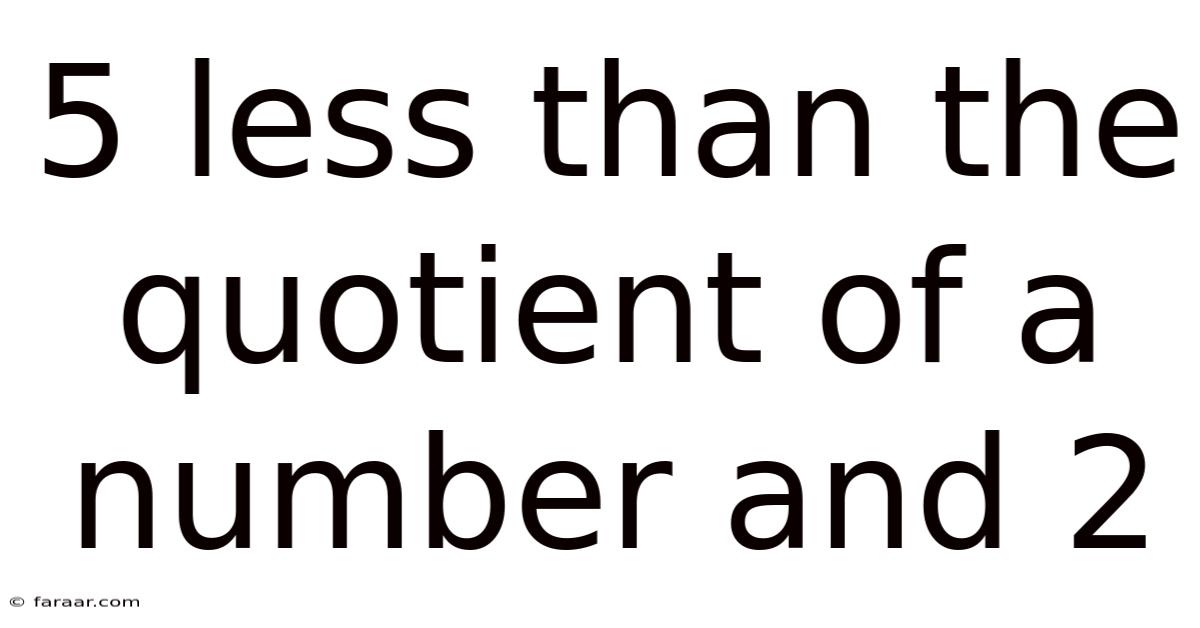
Decoding "5 Less Than the Quotient of a Number and 2": A Deep Dive into Algebraic Expressions
This article will explore the algebraic expression "5 less than the quotient of a number and 2," breaking down its meaning, demonstrating how to translate it into mathematical notation, solving related problems, and examining its applications in various mathematical contexts. Understanding this seemingly simple phrase requires grasping fundamental algebraic concepts, which this guide will comprehensively address. We'll break down the intricacies, ensuring clarity even for beginners while offering valuable insights for more advanced learners.
Understanding the Components
Before tackling the entire expression, let's dissect its individual parts. The core components are:
- A number: This represents an unknown value, typically denoted by a variable, often 'x' or 'n'.
- The quotient of a number and 2: This phrase signifies division. The "quotient" is the result of dividing one number by another. In this case, we are dividing our unknown number ('x' or 'n') by 2. This can be written as x/2 or n/2.
- 5 less than: This indicates subtraction. We are taking 5 away from the preceding value, which is the quotient we just determined.
Translating into Mathematical Notation
Putting these components together, the phrase "5 less than the quotient of a number and 2" translates directly into the algebraic expression:
(x/2) - 5 or (n/2) - 5
Both expressions are equivalent; the choice of variable is arbitrary. This algebraic expression is a concise and precise way to represent the given phrase mathematically. This is a crucial first step in solving problems involving this type of expression Still holds up..
Solving Problems Involving the Expression
Now let's explore how to solve various problems using this algebraic expression. We'll consider different scenarios to illustrate the application of this concept.
Scenario 1: Finding the value of the expression for a given number.
Let's say we want to find the value of the expression when the number (x) is 10. We simply substitute x = 10 into the expression:
(10/2) - 5 = 5 - 5 = 0
That's why, when the number is 10, the value of the expression "5 less than the quotient of a number and 2" is 0.
Scenario 2: Solving an equation.
Suppose the expression is equal to a specific value. Here's one way to look at it: let's solve the equation:
(x/2) - 5 = 3
To solve for 'x', we follow these steps:
- Add 5 to both sides: (x/2) = 8
- Multiply both sides by 2: x = 16
Thus, the solution to the equation (x/2) - 5 = 3 is x = 16. This demonstrates how the algebraic expression can be used within an equation to find an unknown value.
Scenario 3: Word Problems.
Word problems often require translating real-world scenarios into algebraic expressions. Consider this example:
"John's age divided by 2, and then reduced by 5 years, results in 12 years. How old is John?"
This problem can be represented using our expression:
(x/2) - 5 = 12
Solving this equation using the same steps as in Scenario 2:
- Add 5 to both sides: (x/2) = 17
- Multiply both sides by 2: x = 34
So, John is 34 years old. This exemplifies how the algebraic expression can model a real-world situation and be used to solve it.
Variations and Extensions
The fundamental concept of "5 less than the quotient of a number and 2" can be extended and adapted in several ways. Consider these variations:
- Changing the constant: Instead of subtracting 5, we could subtract or add any other constant value. As an example, "7 more than the quotient of a number and 2" would be represented as (x/2) + 7.
- Changing the divisor: The divisor doesn't have to be 2. We could use any number, resulting in expressions like (x/3) - 5, (x/10) - 5, and so on.
- Introducing more operations: We could incorporate additional operations, such as multiplication or exponentiation, to create more complex expressions. To give you an idea, "5 less than twice the quotient of a number and 2" could be written as 2(x/2) - 5, which simplifies to x - 5.
- Using different variables: As mentioned earlier, the choice of the variable (x, n, etc.) is arbitrary; different variables can be used without affecting the meaning of the expression.
Explanation of the Mathematical Concepts Involved
The expression involves several fundamental mathematical concepts:
- Variables: A variable is a symbol (usually a letter) that represents an unknown quantity or a quantity that can change. In our expression, 'x' or 'n' is a variable.
- Arithmetic Operations: The expression utilizes basic arithmetic operations: division (represented by "/") and subtraction ("-").
- Order of Operations: The order in which we perform operations is crucial. In this case, the division must be performed before the subtraction, following the standard order of operations (PEMDAS/BODMAS). Parentheses are often used to clarify the order of operations, especially in more complex expressions.
- Algebraic Expressions: An algebraic expression is a mathematical phrase that can contain numbers, variables, and arithmetic operations. Our expression, (x/2) - 5, is an example of an algebraic expression.
- Equations: An equation is a statement that two expressions are equal. When we set our expression equal to a specific value, we create an equation that can be solved for the unknown variable.
Frequently Asked Questions (FAQ)
Q1: What is the difference between "5 less than the quotient" and "the quotient less than 5"?
These phrases have distinctly different meanings. Plus, "5 less than the quotient" means subtracting 5 from the quotient (as we've discussed). "The quotient less than 5" would mean the quotient is smaller than 5, representing an inequality (x/2 < 5) Simple, but easy to overlook. Less friction, more output..
Q2: Can this expression be simplified further?
In its current form, (x/2) - 5, the expression cannot be simplified further without knowing the value of x And that's really what it comes down to..
Q3: What are some real-world applications of this type of expression?
This type of algebraic expression can be used in various scenarios:
- Calculating averages: If you divide a total by the number of items and then subtract a constant value.
- Determining discounts: A percentage discount off a price followed by a fixed amount reduction.
- Modeling physical phenomena: In physics and engineering, similar expressions might represent certain relationships between variables.
Conclusion
The algebraic expression "5 less than the quotient of a number and 2," while seemingly simple, embodies core principles of algebra. Day to day, through its translation into mathematical notation, its application in solving equations and word problems, and an examination of its variations and underlying mathematical concepts, we’ve developed a comprehensive understanding of this expression and its wider significance. This understanding serves as a solid foundation for tackling more complex algebraic problems and applying mathematical principles to real-world situations. Remember that the key is to break down complex phrases into their constituent parts, translate them into precise mathematical notation, and apply the rules of algebra systematically to solve for unknown values.
This is the bit that actually matters in practice Worth keeping that in mind..
